
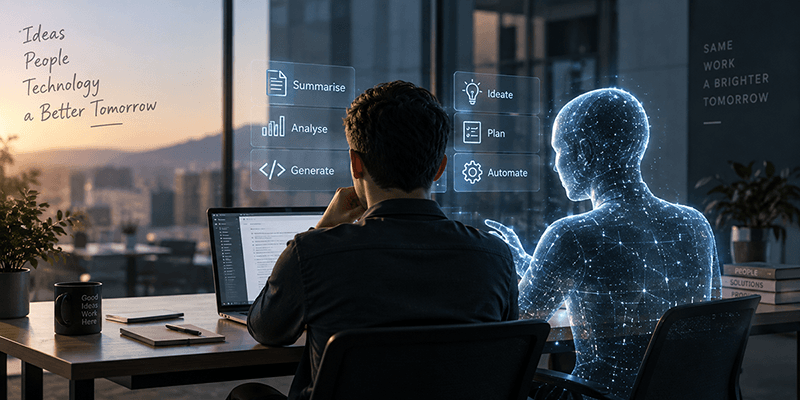
Artificial Intelligence in the workplace
Artificial Intelligence in the workplace
 Giorgos Koutoulakos
Not long ago, using artificial intelligence at work felt experimental. Today, it has been integrated into almost every aspect of our workflow. The technology is moving rapidly — perhaps faster than our understanding of how we should use it.
For businesses, the possibilities are difficult to ignore. AI can take care of repetitive tasks, help employees process large amounts of information, assist with programming and documentation, and provide answers in seconds. Used well, it can give people more time to focus on the work that actually requires their experience, creativity and judgment. And perhaps this is the most interesting part: AI does not necessarily have to replace the person doing the work. It can become another tool in their hands — one that is remarkably fast, always available and capable of handling tasks that once required considerable time and effort. But how much should we trust that tool?
An AI system can produce an impressive answer and still be completely wrong. It can confidently present information that sounds reasonable but has never been fully verified. What happens when an employee accepts that answer without checking it? And what happens when confidential company information is entered into an AI system simply because it seemed like the fastest way to get something done? There is also a less obvious risk. The easier AI makes our work, the easier we may turn into passive participants. If an AI writes the report, analyses the data and suggests the solution, where does human responsibility begin and end?
The challenge is no longer simply learning what AI can do. It is learning when to use it — and when not to. The workplace of the future may not be one where humans compete with AI. It may be one where people who know how to work with AI have an advantage over those who do not.
The real question is not whether AI will become part of our work. It already has.
The question is whether we are ready for what comes next.